An interview with Paul McCorquodale, GridEdge: DialledIn edition #7
12.11.2026
Welcome to edition #7 of Dialled In; diving into the personal drivers behind successful entrepreneurs and founders, beyond the numbers.
Today’s guest is Paul McCorquodale, CEO at GridEdge, an energy optimisation platform for commercial buildings.
Originally spun out of Aston University and backed by investors including bp Ventures, Centrica and Mercia Ventures, Grid Edge helps businesses optimise their energy usage to reduce carbon emissions and cut costs.
Paul spent 16 years at Orange and EE, holding roles across delivery transformation, network integration and service management. He went on to become Chief Operating Officer and Chief Information Officer at Volo Commerce, an eCommerce software business, before taking on the same dual role at energy consultancy Amber.
Alongside his corporate career, Paul also co-founded Making It Simple, a software business developing mobile apps and online ordering technology for small businesses. He joined GridEdge as CEO in 2022, bringing experience spanning corporate transformation, technology, entrepreneurship and scaling fast-growing businesses.
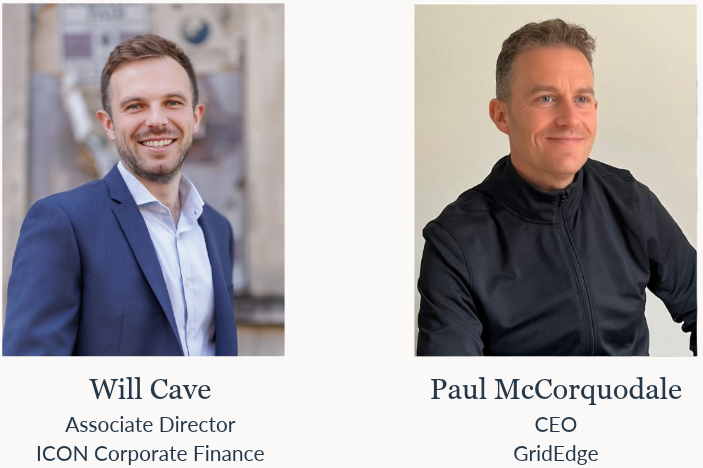
ICON's Will Cave sat down with Paul...
How do you make the big decisions in business?
As a leader, you’re making decisions pretty much throughout your day. Rather than trying to scale the mountain, I like to work out what steps are needed to get there. You can make decisions quite quickly if you break them down into smaller pieces and work through them in cycles.
But if your mind is preoccupied by the busyness of that day, you won’t have capacity to make decisions, whether big or small. You only have so much cognitive fuel to make them. And if your brain is not at the point to make that decision, do not make it. If you’re mentally depleted, go and do something else. Go for a run, go for a walk, get some sleep, whatever it is, and come back to it.
It’s really interesting because everybody tries to avoid making a decision on what they think is ‘gut instinct’. The reality is that gut feeling isn’t your stomach, it’s your subconscious seeing something that your conscious brain hasn’t necessarily picked up yet. You’ve seen these things 20 million times in your career, so your subconscious knows what the answer is. Often, we push it down and try to ignore it, rather than think ‘Why is that happening?’
When I look back and think what could I have done differently, I probably should have listened to my gut instinct more.
What’s the one that got away in your career?
Probably the first business I started.
I’d been in the corporate world for about 16 years, on a journey with a start-up that turned into one of the UK’s biggest companies. I decided that I wanted to get back to the roots of that, which was that entrepreneurial, fast-paced change in the way that you work.
So, I started an online ordering company with a friend of mine called Lee as part of my Making It Simple business. This was probably a few years before Just Eat came into the UK market.
We’d been out one night and got chatting to somebody who ran takeaway restaurants and had a problem. Lee and I have always been problem solvers, and we literally told him we were going to solve his problem. We woke up the next morning thinking, did we really agree that we’re going to solve his problem? We couldn’t let him down.
And so overnight we started this business and developed a platform for processing takeaway restaurant orders. We built it from the ground up and in a way that ran itself because we had full-time jobs.
Technically, it was a very good platform and the market timing was good. But I didn’t take the punt. I wasn’t experienced enough, I wasn’t commercially astute enough and I wasn’t ready to take that level of risk.
That’s the one that got away because we subconsciously built it in a way that allowed it to scale. We built it in a market that was on the verge of happening.
And there are very few moments in a generation that that happens. But looking back, you can kick yourself all day long about the missed opportunity.
The question is, what do we learn from it? What do we do right? And what can we take from that into the next business and the next adventure?
What keeps you up at night?
For me, it’s people. It’s not really the revenues or the commercials. It’s the commitments that I’ve made to people.
I’ve always had this principle: say what you’re going to do, and do what you say. So if I’ve said something to a customer, to my team or to shareholders, I want to make sure I deliver on that.
Basically, business is committing to solve a problem for a customer. And if you aren’t solving those problems, that’s what’s going to keep you up at night.
Then, there’s the people in your teams. One of the things that’s really important is that you’re making a commitment to look after them.
And you’re going to look after them to make sure they’re as successful as they can be in the environment you’re in, and that they will be supported through that journey to help them deliver for the customer, but equally deliver on their careers.
But the third part is in businesses like GridEdge, you’re backed by shareholders and they put their faith and trust in you.
And it doesn’t always go smoothly as anybody knows running these types of companies. It is a roller coaster.
But what’s really important is that you are determined to get there, and keep everybody updated along the way.
I’m really passionate about what I do so I think I’ll always wake up at night. But it’s not necessarily the detail of commercials that’s the trigger, it’s the people, commitments and the trust.
Who do you rely on?
Most people will tell you they’ve got a specific mentor or they’ve got somebody to phone up. And I don’t just have one, I have several.
Currently in my role, I lean on my chairman a lot, because they’ve been there, they’ve done it. And sometimes you need that little sounding board.
Then there’s Jean from an operational perspective, Simon around finance, Ryan around people.
The important part is that I never know all the answers and as soon as you think you know all the answers, things are going to go wrong.
You’ve got to be quite humble and no matter what experience you’ve got, the world moves on and the way things are done changes. So it’s about having people around you that know things you don’t.
I’ve also learnt a lot from just being curious about people. I’m not naturally the most extroverted person, but I’ve realised that you can learn an enormous amount from talking to people and understanding how they think.
And the best mentoring relationships are two-way. They shouldn’t feel formal or transactional. Everybody’s got to win out of it.
The Executive Question
In this series, we ask each of our guests to share a question of their own, which will be put to the next participant to be answered. Heidi Shackell, Former CEO at Lettings Hub, asked:
How do you recognise when the team you have today isn't the team you'll need for the next stage of growth?
I don’t think it’s ever about saying, “This is the team we’ve got today, and we need a completely different team tomorrow.”
You need to know your people. You need to understand their strengths and weaknesses, and you need to understand what the business needs at that particular point in time.
The organisation can change every six months, particularly in a startup. You’re learning so quickly that the requirements of the business change.
I’ve always thought about people as either boosters or drainers. The important thing is getting people into the right seats and aligning them with their passions and natural strengths. If you’ve got somebody who’s operating at 70 or 80%, how do you coach them and evolve them rather than immediately deciding you need somebody else?
Sometimes a person’s journey is going to be different from the company’s journey. If that’s the case, you should help them find the next role where they can be successful.
Ultimately, the company’s success and people’s personal success should align. And that comes down to transparency. There shouldn’t be any surprises.
Follow Paul on LinkedIn here.