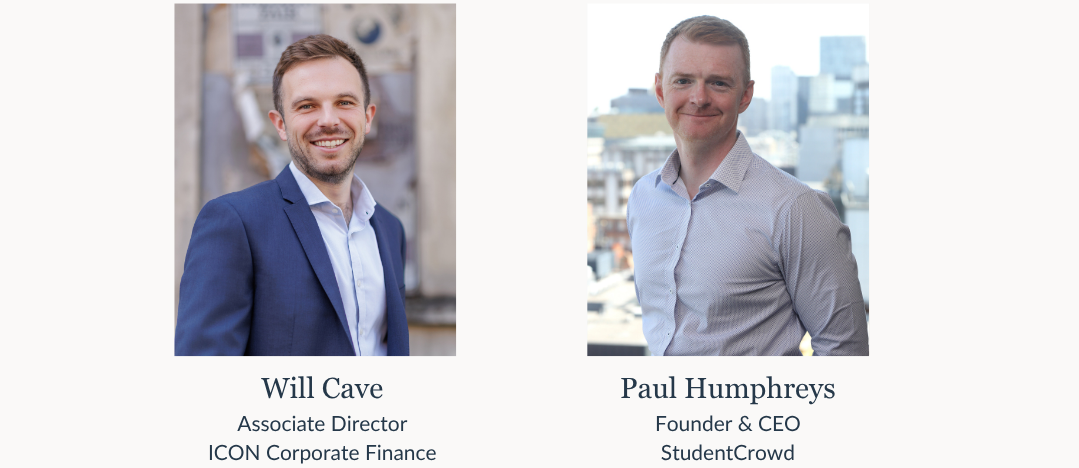
An interview with Paul Humphreys, StudentCrowd: Dialled In edition #6
01.07.2026
Welcome to edition #6 of Dialled In – exploring the quiet reflections through to the big decisions in tech entrepreneurship, told firsthand by the people who lead the businesses.
Today’s guest is Paul Humphreys Founder and CEO of StudentCrowd – the decision-making hub for higher education and student accommodation that has supported more than 14 million individuals in making education-related decisions.
StudentCrowd has completed a $9 million Series A funding round backed by existing investor Mercia Ventures and new investor YFM Equity Partners. The investment will support the company’s next phase of growth, including international expansion, product innovation and the continued development of its data platform serving the higher education and student accommodation sectors.
Alongside leading StudentCrowd, Paul also guest lectures at Loughborough University, where he helps the business school deliver the ‘Year in Enterprise’ programme for placement students starting their own businesses.
Following the raise, we caught up with Paul to discuss what changes as a founder when growth capital arrives, what fundraising really looks like behind the scenes, and the leadership principles guiding StudentCrowd’s next chapter.
ICON's Will Cave sat down with Paul...
StudentCrowd has just completed a $9 million Series A funding round. This isn't the first time you've raised capital for the business. How did this raise differ from previous rounds?
This round was a significantly larger raise than our previous rounds, which gives us the ability to accelerate product innovation, expand internationally and invest in the next phase of StudentCrowd’s growth.
It was incredibly encouraging to see Mercia continue to back the business and follow their money, whilst also welcoming YFM as a new investor with conviction in what we’re building.
The biggest difference was the additional complexity. With multiple parties involved stakeholder management naturally becomes more complex. At the same time, the business itself was evolving rapidly. We were launching into the US, expanding across Europe, recruiting key senior hires and continuing to scale the platform, all whilst running the investment process.
The original investment helped us build the foundations of the business. It enabled us to grow the team, scale the platform and reach a position where the business could stand on its own two feet. This raise feels different. It’s growth capital. It’s about doubling down on the things that got us here in the first place, whilst investing in the opportunities ahead.
One thing I’m particularly excited about is our ability to accelerate innovation. We’re investing further in the product, working more closely with customers through initiatives such as our Innovation Council and continuing to build the data and insights capabilities that help students make better decisions.
Going through the fundraising process also gives you a chance to stress-test the business. Investors ask difficult questions, challenge assumptions and scrutinise every aspect of the company. Coming through that process leaves you with greater conviction. I genuinely believe we’re in a stronger position today than we were at the start of the year, and better equipped for the next stage of growth.
You've just completed a successful Series A and secured capital to support your next phase of growth. What's the biggest misconception people have about what happens after the money lands in the bank?
It’s probably less glamorous than people imagine.
People often imagine that fundraising ends with a big celebration and a sense that you’ve somehow “made it”. The reality is quite different. You celebrate the small milestones along the way. You celebrate when a term sheet is agreed. You celebrate when a diligence report comes back positively. By the time the money actually lands, it’s often more a feeling of relief than celebration.
Fundraising takes a huge amount of time and energy. One of the biggest differences after the round closed wasn’t seeing the cash in the bank account; it was simply getting my time back. Suddenly, I wasn’t spending a significant portion of my week on the investment process any more. I could focus entirely on the business again.
What’s exciting isn’t the money itself. It’s what the capital allows you to do. For us, that’s delivering on the opportunities we’ve identified over the last few years.
The reality is that fundraising isn’t the finish line. It’s the starting line for the next chapter. Once the deal is done, the focus quickly shifts from raising capital to delivering on the vision you’ve shared with your investors, your team and your customers.
And then, of course, the real work starts.
With fresh capital secured and the next phase of growth underway, we turned the conversation to leadership, decision making and the habits that have shaped StudentCrowd's journey to date.
How do you make the big decisions in business?
Well, big decisions come in lots of different shapes and sizes for us.
When we make decisions on what to focus on as a business, listening is the key. So we listen to all the stakeholders in the company. And I’d say primarily: students.
StudentCrowd exists to help students make the best decisions. And we know that we thrive best when we listen. We listen to those students. The next group would be clients: all of our revenue comes from our B2B clients, and a large part of our growth has been listening to what the clients really need, and then delivering on that.
And then also the team, including our advisors. Listening to the team is something I care deeply about. Earlier in my career, I poured a huge amount of time and effort into a project I was genuinely excited about, only for it to be filed away and forgotten. It was incredibly demotivating and taught me the importance of genuinely listening to all members of the team.
That experience still shapes how we operate at StudentCrowd. When we ask the team about strategic priorities, we genuinely listen and make a point of showing how their input influences decisions. We combine those perspectives with data, but there’s always an element of judgement too, particularly when it comes to timing.
So it is quite hard to answer the question “how do you make the big decisions?” But I’d say primarily, for StudentCrowd and our leadership team, we do prioritise listening to all perspectives.
What's the 'one that got away' in your career?
What I would say is that I’m wired to spot opportunities, to dream up solutions and then build them. If there’s something that did get away, it’s probably ideas. I’ve got a lot of them. And sometimes, if they’re not related to StudentCrowd, I’ll just write them down… but I’d need multiple lifetimes to build them all. I wonder if other people wired like me feel the same. I don’t have regrets. I think it’s important to focus, and I’m absolutely focused on building and growing StudentCrowd. The other ideas just form a very long note on my phone.
One example would be student bank accounts. We’ve received over 10,000 verified student reviews about bank accounts. It wouldn’t be too much work to make those live, to develop the tech to help students pick a bank account and work with the banks. But we’ve made so much progress in student real estate, and there’s so much focus there, that it would be a distraction.
What keeps you up at night?
Honestly, I sleep quite well. And I think a big reason for that is the team.
At StudentCrowd, we’ve only ever had two values: freedom and responsibility. That first one means people are given real autonomy to create and deliver in their roles. And the second is about holding meaningful responsibility, whether you’re in a senior leadership position or just starting out. That shared ownership is what lets me sleep at night. The burden of running the business doesn’t sit with just one person. It’s distributed across a group of brilliant people, all leading their areas with care and commitment.
I’d also say rest is something we really value as a company. With a clear mind, you can solve a problem in five minutes that might otherwise take five hours of stress and late nights.
We actively encourage people to rest, to take proper time off. If we ever found out that someone on the team was losing sleep over work, we’d want to fix that. That’s not how we want to operate, and it’s not the kind of culture we want to build.
In the earliest days, when it was just Pete – my co-founder and our CTO – and me, sure, we carried all the responsibility. But the surface area of the business was tiny back then. The problems were smaller. These days, with a much larger team, more clients, and lots of ways external people engage with us, the surface area is far bigger. And with that comes the need to share responsibility in a healthy way.
Who do you rely on?
I definitely rely on the team. We’ve recruited really well, and I almost see it like a structure, like a series of pillars that we lean on.
At StudentCrowd, I rely very heavily on the leadership team. But really, it’s the whole team. Everyone holds real responsibility, and they hold it well.
If I had to single out one person, it would be Pete, my co-founder and CTO. He has a huge impact on the culture of the company. We’ve been leading the business together for a long time, and we’ve definitely learned how to rely on each other. We’re quite fortunate in that we’re strong where the other is weak. And where we both fall short, we’ve built around that with some really excellent people.
I’d also mention my wife, Amy – we’ve been married for 16 years. I’m certainly heavily reliant on her for the rest of life outside work. I’m very fortunate in that regard.
Another pillar would be friends. I’m fortunate to have good friends outside the business, and increasingly, a number of friends within the sector too. I definitely rely on both.
And lastly, our advisors. We’ve had a series of advisors from the early days, people who genuinely care about us, not just about the business. They’ve shared stories from their own journeys, encouraged us to rest when we needed it, and given really solid strategic input. We’ve been very fortunate there, too.

In this series, we ask each of our guests to share a question of their own, which will be put to the next participant to be answered. Prembly CEO, Lanre Ogungbe, asked:
There are advisors out there who ask for a chunk of equity before they advise you. Is this a good idea? How do you hold that advisor to account?
Honestly, I think if someone wants a chunk of equity before they start advising you, that would have been a red flag for us in the early stage.
By the very nature of being an advisor, they must have achieved something meaningful. So if they’re looking for equity straight away, I’d want to see them actually doing some work in the business first. I’d also recommend using options rather than giving away a direct chunk of equity. Options can be structured to vest over three or four years, and there are mechanisms in place that help hold the advisor to account. It helps balance the risk on both sides.
There’s also another angle: if they’re genuinely successful and believe in what you’re doing, they might be able to invest instead. Even a relatively small investment lets them buy those shares, maybe at a favourable rate, rather than just being handed equity upfront.