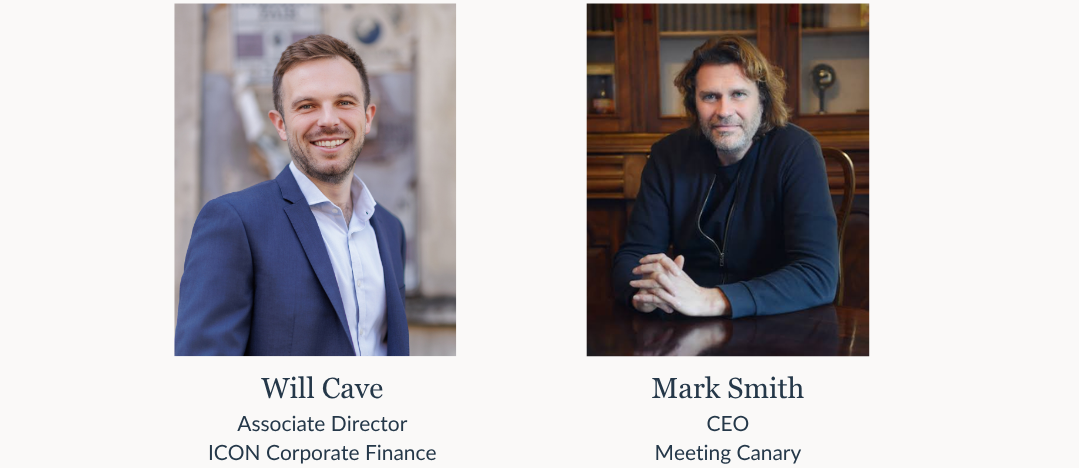
An interview with Mark Smith, Meeting Canary: Dialled In edition #2
10.02.2025
|
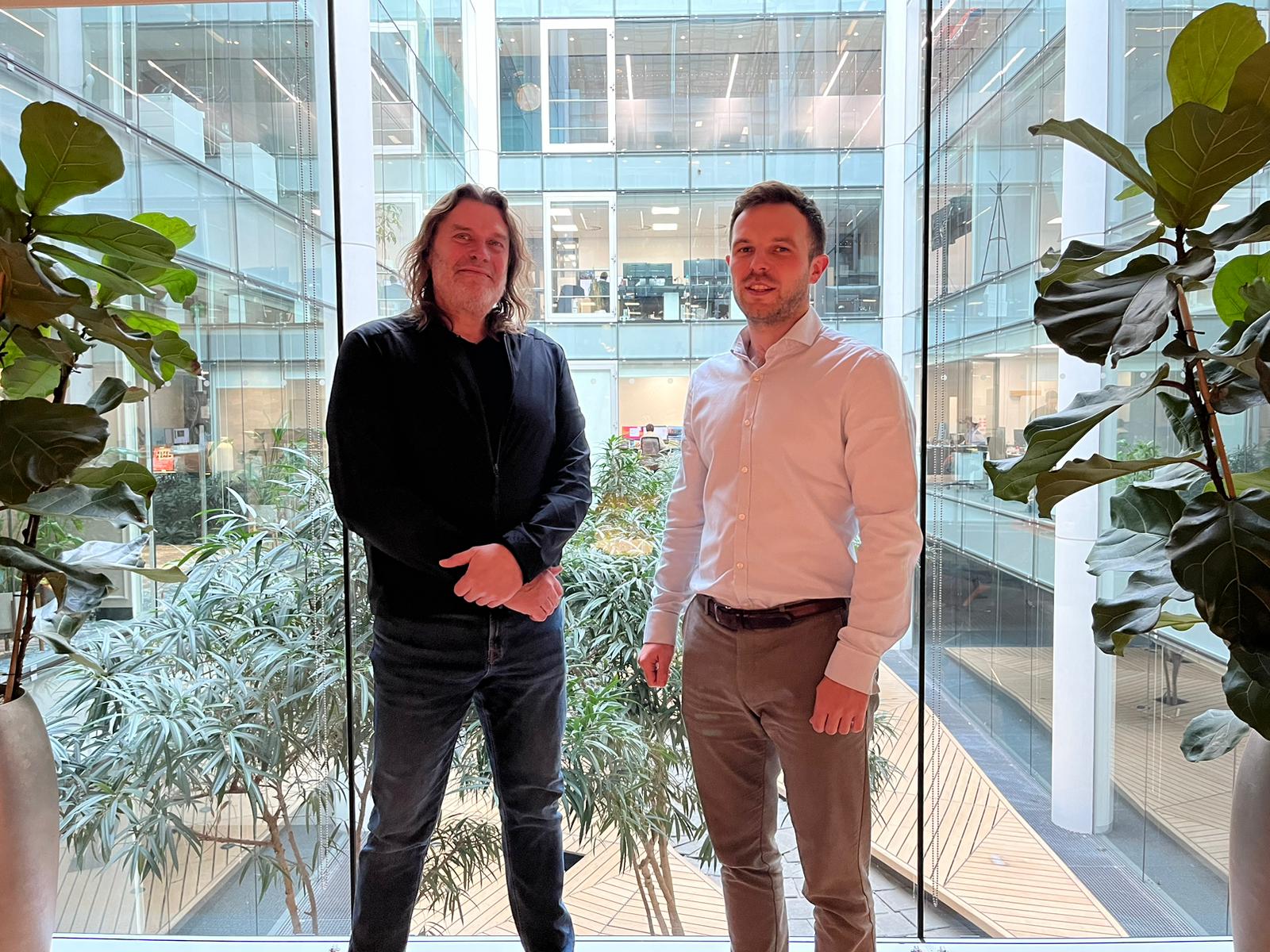
ICON's Will Cave sat down with Mark...
How do you make the big decisions in business?
When you first start a business, you have very little evidence of what will be successful. So, in the beginning, decision-making is largely instinctive. In my case, every business I’ve been involved with has started from an idea – sometimes mine, sometimes someone else’s – but at that stage, there’s no data, no evidence to rely on. I’m a scientist by training, so I think of it like forming a hypothesis before you’ve collected any data. You’re essentially making educated guesses.
You can try to validate your idea through market research, but research almost always suggests that your idea has been done before. The challenge is that we live in a post-truth world, so it’s hard to separate what’s real from what’s just being claimed. That’s why, in those early stages, you have to trust your instincts.
The second step is exposing your idea to people whose opinions you trust, ideally from different disciplines. That’s what I do. When we started Meeting Canary, the premise was simple: there are too many online meetings. I experienced it first-hand. Meetings used to be rare, but now they fill every minute of the day. So, we took that idea and validated it by talking to smart people who shared similar frustrations. That feedback helped shape the idea into something more tangible.
The third, and probably the most critical, step is listening to the market. Once you put your product into the business ecosystem, you finally get real evidence. At that point, decision-making can be based on actual data. That evidence comes from exposing your product to a community – ideally, customers who are willing to pay for it. If more than 50% of your initial assumptions are correct, you’re in a good place.
There’s one caveat: I believe instinct improves with age. There’s research suggesting that successful entrepreneurs are often older than you might expect, and I think that’s because experience enhances decision-making. Your brain is like a database – imperfect, but with memory – and the more experiences you’ve had, the better your instincts become.
Ultimately, good decision-making is about balancing instinct, input from trusted people, and hard evidence from the market. And never assume you’re 100% right. If you do, you’ll fail. That’s why only 1 in 1,000 tech companies make it to $1 million in revenue.
What's the 'one that got away' in your career?
That’s a really interesting question. A lot of people like to say, “Oh, I was doing Facebook before Facebook” or “I was working on WebEx before WebEx.” I’ve claimed things like that before. But I think it’s a false errand to dwell on those thoughts.
There are billions of people in the world, and every single one of them has a brain, which means, almost by definition, everyone has a great idea at least once in their life, sometimes more. But having an idea is meaningless without execution. It’s all in the application, in making things happen.
That said, I did create something that resembled a social network long before Facebook, specifically in the field of autism. It was an online group where people could interact using what was then called Internet Relay Chat – now just “chat” – allowing them to engage around specific topics. We also held seminars and conferences with experts, creating a community where geographical barriers and availability no longer mattered. But it’s not the same as Facebook, and even if I had pursued it, I would never have built what they did.
In another example, I was once credited back in the mid-1990s with inventing online conferencing. This was in 1996, nearly 30 years ago. At the time, we were working on ways to enable real-time interaction through video, audio, and text – essentially, what we now know as Zoom, Teams, or WebEx. I do regret not pushing that further.
One of the big technical challenges we faced was the need to constantly poll another person’s computer to check if they were still online and receiving data. It sounds trivial now, but at the time, it caused significant technical issues with browsers. We ended up walking away from it.
We did hold several online conferences, and that business was later IPO’d on AIM in April 2000 – a very significant moment in dot-com history (the day the markets crashed!). Looking back, that company could have evolved into something like WebEx and, later, Zoom or Teams.
Do I regret not pursuing it? Not really. I don’t think it interested me enough. I’ve always been more fascinated by facilitating engagement between people, making communication easier and more meaningful. The core of a telco-style business just wasn’t my thing; I would have lost interest quickly.
What keeps you up at night?
Not a lot, actually. There was a time, probably more than ten years ago, when technology used to give me sleepless nights. When we were really pushing the limits of what was possible, the fear was always that it wouldn’t work. In my first business, we were running real-time online conferences for thousands of people. That would keep you up at night because if something went wrong with the servers, it just stopped. Unlike a physical venue, where you can scramble to fix things, when tech fails, you’re properly knackered.
In my last business, we were communicating with literally millions of people a day. There were multiple points of failure in that, which was terrifying. And sometimes, the failure was your own doing; other times, it was just the complexity of the service providers involved.
But where I am now, technology is much more robust. If something goes wrong, you can normally trace it back and work out what happened. That makes it less stressful. Unlike biological systems – where, when something fails, you might have to go back to the lab to figure out why – IT systems are, by nature, unpickable. That certainty helps.
Financially, I’ve had some success in recent years, so the fear of failure isn’t what it used to be. It’s different when you don’t have your house on the line. That used to keep me up at night; paying for private schools for my three kids, making sure everything was stable. But now? Not so much. I’m spectacularly relaxed, mostly. And that actually helps with clearer thinking. When you’re not terrified that everything’s about to fall apart, you make better decisions. The best gamblers are rich gamblers.
When I look back, I realise it was never worth losing sleep over. What we were doing was never a matter of life and death. If a text message about someone’s washing machine repair didn’t go through – so what? It doesn’t matter. At the time, though, it felt like the most important thing in the world. That was probably more about pride than anything else. I hate losing. I’m really, really bad at losing.
Who do you rely on?
So, there are some things I’m really good at. I’m driven, I’m quite persuasive, I’m reasonably articulate. I have the benefit of experience, age, and background, so I can deploy those skills where necessary.
But there are plenty of things I’m not so good at. Business administration, broadly speaking, is one of them – the very idea that I have to fill in a form of any kind is horrifying. I barely recover from my tax returns. So throughout my career, I’ve always gravitated toward people who have those skills. In a sort of parasitic way, really – every single time, early on, I’ve found people who can handle the operational and administrative side of things: the certifications, the contracts, the endless form-filling. We’ve obviously had advisors for that, too, which is tremendously helpful, but I always make sure there are people in the team who can do it.
I’m quite good in a sales context, but I’m not a salesperson. One of my issues with technology is that once I’ve explained to someone what the tech can do, and I’ve evidenced that it works, I find it inexplicable why they wouldn’t immediately buy it. And that, as it turns out, is not a great sales technique. So I’ve always needed people who can handle that aspect of things.
I hesitate to say “visionary”, but I’m good at seeing the broader picture – at figuring out what’s possible. That’s why I’ve often had sales teams full of people I don’t necessarily like very much, but who fill that gap. And that’s particularly important when you’re trying to scale a business. In my last company, we went from zero revenue to £50 million in revenue. The first few contracts I won myself, or collaboratively with others, but that growth happened because there was a sales machine behind it. And that’s something I’m not terribly interested in. Winning the same argument again and again just doesn’t excite me. It’s a bit like teaching; having to explain something you’ve already explained before.
Beyond that, I’m comfortable with most other aspects of business. I’m quite good at putting teams together. I pride myself on being inclusive in that process, too – I’m forever saying, There’s no monopoly on good ideas, because there isn’t. Good ideas come from everywhere in an organisation, and everyone should have the opportunity to contribute.
In this series, we ask each of our guests to share a question of their own, which will be put to the next participant to be answered. Vita Mojo CEO, Charlie Horrell asked:
What are the metrics of diversity that you're looking for outside of the obvious ones, such as gender?
Here’s the thing: I’ve run deep tech companies my entire life, doing some very radical stuff, and yet, I would argue that much of it has been outside my academic discipline. I was an ecologist – a biochemist, I suppose – a data person, but not a mathematician. I’ve never written a line of code in my life, nor would I be any good at it. And yet, I’ve led companies built on disciplines I’m not an expert in. That in itself is a form of diversity; academic diversity.
Then there’s the question of how you measure it. For two-thirds of my career, we did straightforward software engineering. If you put a group of accountants in a room, or a group of physicists, or a group of software engineers, the range of thought within that group is relatively narrow because they’ve all been trained the same way. But when you bring those different disciplines together, the overlap becomes far more interesting. And brilliance isn’t found in the middle of the bell curve – it’s at the extremes.
There are plenty of historical examples of this. My favourite is Bletchley Park during the Second World War. They had early examples of DevOps, software engineers, psychologists, linguists, physicists, men and women – a tremendous mix of minds – to, quite literally, crack the code. If they’d relied solely on one discipline, they wouldn’t have succeeded. So, to me, it’s always been obvious that a mixed team of mixed intellects leads to better outcomes. And if you use money as the metric, that proves it. There’s a great quote from a Canadian entrepreneur: It’s not about money – that’s just a way of keeping score.
In my last business, for years, we were purely a software engineering company. But then, about seven years ago, I had a realisation, one that I should have had much earlier: AI, particularly machine learning, isn’t a software engineering discipline – it’s a mathematical one. Machine learning is statistical learning. It’s complicated maths.
So I told the software engineers, I don’t care about your approach to AI, because all they were doing was connecting APIs to other services – that had no value to me. Instead, I hired a completely new team: mathematicians, a geographer, psychologists, physicists, linguists, mechanical and electrical engineers, an economist. About a dozen people, mostly in their early 20s, with little to no work experience but clearly very smart – typically from top universities, often with first-class degrees. I paired them with a few more experienced team members, and together, they built AI that outperformed the off-the-shelf products from Google, Microsoft and IBM. Gartner recognised us as one of the most advanced in the field, despite being a fraction of the size of our competitors. That team was also 50/50 men and women – not by design, just by outcome – and it worked brilliantly. I was hugely proud of that.
With Meeting Canary, we’re taking that a step further. It’s not just about reducing unnecessary meetings or improving agendas, it’s about measuring inclusivity. We can analyse whether people are being talked over, whether ideas are being stolen, whether inclusive language is being used. There’s a feminist concept called “hepeating,” where a woman suggests an idea, it’s ignored, and then a man rephrases it and gets credit. We can actually track that happening.
We’ve even linked sentiment analysis to names and pronouns, so we can show whether sentiment is skewed negatively or positively by gender. Race is harder. Computer vision is rubbish at determining it, and surnames or first names aren’t reliable either – but we’re getting closer to proving the impact of diversity with real data.
The reality is undeniable: more diverse teams lead to better outcomes. I’ve seen it throughout my career. And soon, we won’t just be able to say that – we’ll be able to prove it.