An interview with Lanre Ogungbe, Prembly: Dialled In edition #4
20.07.2025
Welcome to edition #4 of Dialled In – shining a light on the mindset behind building and scaling tech businesses through candid conversations with the people who have lived it.
Today’s guest is Lanre Ogungbe, Co-founder and CEO at Prembly – the data infrastructure company building security, compliance, and verification tools with the aim of making the internet a safer place.
Lanre previously helped to scale cloud-based accounting software platform Accounteer before its exit to Float in 2022. He also served as a strategic advisor for Johns Hopkins Technology Ventures in 2023 and is a member of the Forbes Business Council.
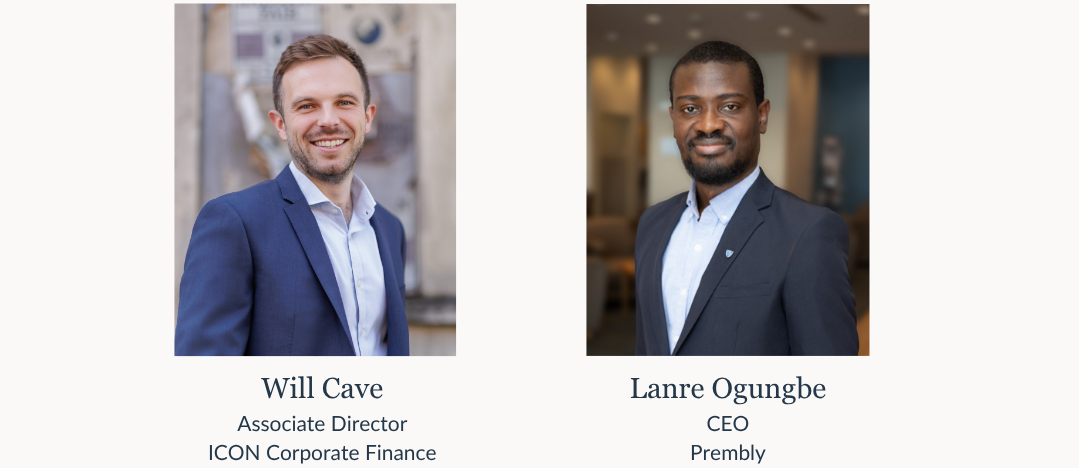
ICON's Will Cave sat down with Lanre...
How do you make the big decisions in business?
For me, it really depends on the kind of decision, but there are a few go-to tools I use. First, of course, is data. You want to be able to defend the call you’ve made – and having the data helps with that.
But sometimes, it’s instinct. I think as business leaders, we rely heavily on gut feel. We take bets that might not make sense to anyone else. Sometimes, we even go against what the data is saying – because something in us believes, no, this will work. And if it doesn’t, at least we tried. That’s part of being an entrepreneur; you’ve got to have risk appetite.
Thirdly, I look to history. A lot of the decisions we’re facing today have probably been made before – maybe in different contexts, but they’ve happened. So I often take time to research what’s been done in similar situations. And if I don’t have enough historical touchpoints, I’ll talk to people – ask around. Someone’s always got a reference or example that can inform my thinking.
Now, I don’t use all three every time. Sometimes data alone is enough – especially when it’s a product or customer-facing decision. But if it’s something more strategic – like an expansion decision – then instincts tend to play a bigger role. So depending on the decision, I might use one, two, or all three.
I have this theory: before you even start analysing anything, you’ve usually got a preferred outcome in mind – just like when you’re apartment-hunting. You already have a sense of the area you want to live in. Data then becomes a tool to confirm or challenge that assumption.
So how much data is enough? It’s a function of your willingness to accept that you might be wrong. And that can get tricky. Say you’re analysing five data sets – only one supports your point of view. Sometimes, you’ll ignore the other four and say, “Well, this one says yes, so let’s go.” And that’s where instinct comes back in – you’ve got to check yourself: Am I really making an objective decision here?
There’s no perfect answer. The golden rule is: don’t manipulate the input. Let the output speak for itself. If you’re feeding in garbage, you’ll get garbage out. But if you keep the process objective, and combine that with instincts and historical insight, you’ll land in a good place.
What's the 'one that got away' in your career?
That’s a tough one – I’m honestly struggling to answer it, not because I haven’t had setbacks, but because of the way I choose to approach them. I try to move on quickly. It’s not that I don’t reflect – I do – but I don’t tend to see losses as losses. I see them as learnings.
If I lose a deal or a professional relationship, I don’t dwell on it. That’s just me. I’ll often find a new narrative for the experience – something that frames it in a way that’s useful. So, no, I can’t point to a single “one that got away.” I’m not saying they don’t exist. I’m saying I don’t hold onto them in that way.
I go into anything – whether it’s a job, a project, or an investment – with a 50/50 mindset. It may work, it may not. And when it doesn’t, I already have that buffer in my mind. I just file it under: It was always a possibility. Then I take the lessons and move on.
I think of myself as either a marathon runner or a soldier on a battlefield. If you’re running a marathon, you’ll get overtaken. You’ll trip. You’ll fall. That doesn’t mean the race is over. You keep running. Maybe you don’t win this one, but you’ve built the endurance to run another.
And if you’re on the battlefield, yeah – you’re going to take some hits. But you keep going. You fight until the end. That mindset helps me. I count my losses, sure, but I don’t burn bridges. I don’t close doors. Because in my experience, things often come back around.
A few years ago, for example, we lost a major customer – significant revenue vanished overnight. Three years later, they came back. Today, they’re in our top 10% of clients. As long as you keep the door open, things can return.
That said, some things don’t come back. And the key is what you do while you’re waiting. You can’t let a lost opportunity define your current state. The time in between matters. If you missed something because you weren’t ready – maybe your pitch wasn’t sharp enough or your customer support wasn’t good – what are you doing about that now?
That’s what being human is, right? We lose things, we gain things, we make mistakes, we learn. No one wins everything. We’re all just trying to end up with more positives than negatives. But we shouldn’t be ashamed of the mistakes – we should be using them.
What keeps you up at night?
The one that really keeps me up at night is: How much more impact can I make?
That’s the big one. And it’s not just a throwaway line – I’m in business because I genuinely want to make an impact and help people. I know a lot of businesspeople say that, but for me, it’s true. Business is a means. Technology is a tool. The goal is change.
I’ve always believed that two of the sharpest tools we have to change lives at scale are governance and technology. Policies affect us all, no matter where we are. And technology – it’s inevitable. Whether you like it or not, it’s going to evolve, and it’s going to change how we live, work, and relate to the world.
So I ask: Can we use technology to advance humanity? To give more people access to opportunities?
If we look back 200 years, 100 years, even just 40 years – we’re better off now. We’re more educated, more connected, and we’ve got more potential than ever before. That’s because of technology. But there’s still so much more to do. And that’s what drives me. There’s never “enough” impact.
On a more traditional business level, like every other founder or CEO, I do worry about growth. I don’t want to get too comfortable. Business might be good, maybe we’re making millions, maybe more. But I’ll still be asking, What’s broken that I haven’t seen yet? Or, Sure, we’re making sales – but how do we make more? That kind of thinking never really switches off.
And finally, there’s a personal ambition that sits behind everything I do – investing in people. Not institutions, not just products or systems, but actual people. I believe that if you focus on people first, everything else follows. You can build skyscrapers, but if you haven’t invested in the people who live and work in them, what’s the point? I’d rather build the people, and trust that they’ll build the skyscrapers.
So yes, I know I’m already having an impact – through the people we employ, the customers who benefit from our software, the communities we touch. But I also know there’s a much bigger version of this story still to be written. And that’s what keeps me up at night: the ambition to do more.
Who do you rely on?
My family. After my family, I’ve got some very good friends as well. You know that concept of low-maintenance friendships? The kind where you don’t speak for six or nine months, then when you finally do, you just download everything that’s happened in your life in one go, say “bye,” and don’t talk again for weeks? I’ve got a few friendships like that. They’re special.
But really, I rely heavily on my family. They’ve always been there. They’re always going to be there. My parents are solid. Sometimes all you need is someone who believes in you. I know we all need money, shelter, the basics – but sometimes the real fuel is just having someone who says, Hey, I believe in you. Because when someone believes in you, you’ve got no excuse not to believe in yourself. That’s powerful. And for me, my family gives me that.
Of course, when it comes to business, I rely heavily on my business partners. They’ve become my friends too – just not low-maintenance ones, because we talk every single day! So yeah, I’d call them high-maintenance friendships. But they matter. They’re in the trenches with me, and I trust them.
I try to keep my circle small. You don’t need a crowd – you just need a few real ones. People who will cheer for you, yes, but also people who will call you out. That’s important. I tell the people close to me: Don’t just be my cheerleader – be honest with me. If I mess up, tell me. Call my BS. Look me in the eye and say, Hey, you missed it there. That kind of honesty is rare, but it’s what I value the most.
Because you don’t want to be the person who’s always right, the person who knows everything, the smartest person in the room all the time. That’s dangerous. I’ve met people who hate being corrected – but I think that’s a recipe for failure. You have to be teachable. No matter how successful you are. Even if you’ve got ten PhDs, you still don’t know everything.
We all need people who can keep us grounded. Those are the ones I rely on.

In this series, we ask each of our guests to share a question of their own, which will be put to the next participant to be answered. Relative Insight CEO, Ben Hookway asked:
Demand generation has never been more important or complicated for B2B businesses. What are the best practices in what is a rapidly evolving discipline?
That’s a big one. I’d actually start by saying: it depends. Even in B2B, it really depends on the industry you’re targeting. Whether you’re selling into oil and gas, or software, or services – it’s not one-size-fits-all. The strategies you apply vary massively depending on that.
Now of course, tech is changing everything. AI is changing everything. It’s challenging how we qualify leads, how we acquire customers – it’s changing the game. But even in the middle of all that change, some best practices still stand. They’ve always worked, and they still work.
First one? Optimize for word-of-mouth lead generation. Still, hands down, one of the best channels – because if your existing customers or partners are out there talking about your product or service, you’re reducing your marketing spend while building real credibility. That’s gold.
How you do that will vary – some industries might need a proper referral programme, others might lean on event marketing or a rewards-based system. But whatever it is, the goal is the same: get people to bring other people in.
Because in B2B, trust is the currency. It’s not like D2C, where it’s all about popularity or virality. In B2B, people don’t buy from you unless they trust you. So whatever builds trust – referrals, relationships, peer validation – that’s where the focus should be.
Second thing I’d say is about content. Especially now, with the rise of AI tools – the content you put out is even more important. You need to be really specific about what you do, and how you talk about it online.
Before, businesses could get away with writing generic blogs or overviews. Now? If someone asks an AI tool to recommend the best payroll software for the construction sector in the UK, the AI is scraping super-specific sources.
So my advice is: be more thorough and more precise in your content. Don’t assume people – or AI – know what you mean. Spell it out. Make sure the language you use is directly aligned with how your audience thinks and searches.
Those are the two things I’d focus on. Build trust through people. And make your content work harder, smarter, and more specifically for you.