An interview with Ben Hookway, Relative Insight: Dialled In edition #3
20.05.2025
Welcome to edition #3 of Dialled In – unpacking the mindset of successful tech entrepreneurs who’ve navigated the highs, lows, and everything in between.
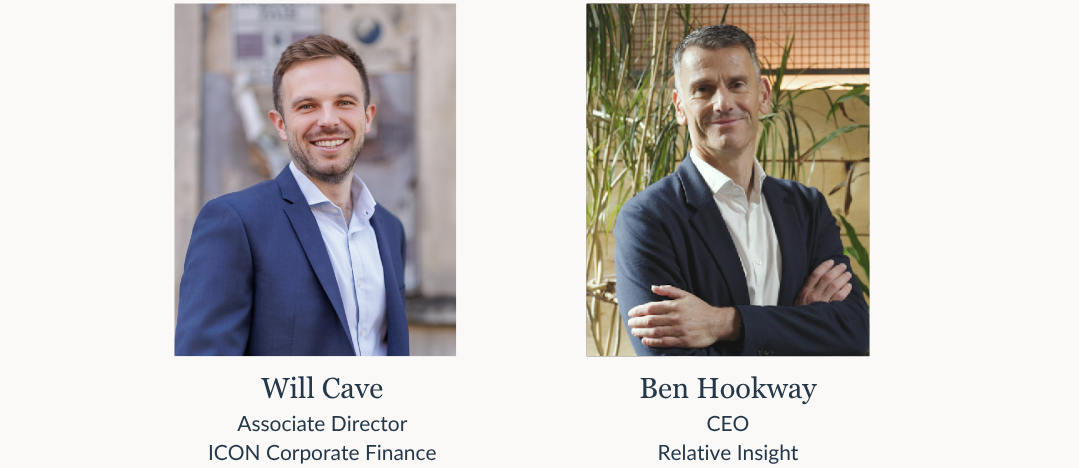
Today’s guest is Ben Hookway, CEO at Relative Insight – the leading AI-driven Customer Intelligence Platform, helping businesses of all sizes unlock value from unstructured customer data sources.
Ben was previously Founder of Next Device Ltd, the advanced 3D user interface technology provider, which was acquired by Mentor Graphics in 2006.

ICON's Will Cave sat down with Ben...
How do you make the big decisions in business?
That said, the decision is always yours. You can get input from investors, your team, even your family – but if it goes wrong, it’s on you. And when you know, you know. The real danger isn’t making the wrong call, it’s analysis paralysis – delaying when you already have the answer.
In hindsight, most regrets aren’t about what you decided, but about how long it took. A CEO once told me, “If there’s doubt, there’s no doubt.” That rings true. The biggest mistakes I’ve made weren’t the decisions themselves, but not acting fast enough.
That’s why I always document my rationale. It’s not just for me – it’s for my team and investors. People are fine with decisions they disagree with, as long as they understand why they were made. What frustrates people is vagueness or evasiveness.
Leadership often means making unpopular choices. But here’s the truth: you’ll spend way more time agonising over a decision than anyone else. The higher up you are, the harder the calls get – because by the time they reach you, it’s a 49-51 decision. Either way, someone won’t be happy. That’s the job.
What's the 'one that got away' in your career?
I don’t have a moment that stands out as ‘the one that got away.’ Maybe I’m just not sharp enough to see the opportunity I missed – I don’t know. But I think all you can do is make the best decision with the information you have at the time, and then you move on. That’s life.
People sometimes ask me about a previous business I had. We sold it quite early, after seed funding, and I get the question: Do you wish you’d held out, raised a Series A, gone for a bigger valuation? But for me, that wasn’t one that got away at all. It was a mobile phone software business, and we could see the market was condensing around platforms. We thought, We’ve been diluted a little, we’ll make some decent money, maybe even enough to retire early, so let’s get out and move on. We’d had 18 months of funding, which was pretty good. Time to do something else.
I also spent six years working in the U.S. I was on a grad program with Fujitsu, got sent there for six months, and it turned into six years. Late dot-com boom, 2000. It was wild. People think today is crazy, but back then? Completely berserk. No open source, no cloud. You had to buy your own servers, your own software. You couldn’t open the doors for less than five million dollars.
And sometimes, after all that, you look back and think, Was I the only guy in Silicon Valley who didn’t come out minted? But the reality is, most people didn’t. There wasn’t a single moment where I thought, If only I’d done X differently, everything would have changed. That’s just how it played out.
What keeps you up at night?
Alignment. As companies grow, keeping alignment on what’s truly important – and the level of detail needed to scale – is probably the biggest challenge.
When I say alignment, I mean from investors and the board down to the CEO, my direct reports, their direct reports, and beyond. The bigger an organisation, the more naturally that focus starts to dilute. So at different stages, you have to ask: How do you define the key thing? That’s where a really clear vision and mission statement come in.
Another part of this is making sure people understand the company’s objectives versus just managing their own department. I stole this from a Notion podcast; it really stuck with me.
Company objectives are usually financial: revenue, growth, gross margin, EBITDA, and so on. But as a company scales, you delegate operational responsibility, and people start to develop objectives around their function. Let’s say you have a Head of Professional Services responsible for implementing your software. It’s easy for that person to think their goal is to build the biggest professional services team possible, because that’s their world. But in reality, their job isn’t to grow their team indefinitely; it’s to maximize impact with a constrained resource. You don’t want a massive services team eating into your margins just because someone is focused on empire-building rather than efficiency.
It might sound subtle, but you’d be amazed how often leaders conflate their department’s success with the company’s success. And if people don’t understand the difference between objectives and resources, you get misalignment.
And here’s the thing – alignment is all about clarity and repetition. A CEO is basically a Chief Repetition Officer. You have to say it, say it again, and then say it again until you feel like you’re going to puke if you have to say it one more time… and then you say it again. Because if you think, I’ve said this a couple of times, surely everyone gets it – they don’t. You have to repeat and repeat and repeat.
But nobody wants to hear the CEO banging on 24/7, so you have to be really deliberate about what you want aligned and how you express it. I’m not saying I’ve mastered it, which is probably why this is the thing I lose sleep over.
Who do you rely on?
There are three groups of people I rely on.
First, my direct reports – my exec team. That’s the obvious one, but I’d reframe the question slightly: What do I rely on them for? And the answer is their behaviour. I need them to be excellent – highly competent, of course – but also low ego, genuinely cooperative, open, and appreciative of the difficulty of each other’s jobs. If you get all of that, it doesn’t necessarily make things smoother. In fact, it can create more conflict. But conflict without malice is a great thing – it means people care, and you’ve got to talk about stuff. As a leader, you have to set the scene for that and make it clear that it’s expected. Because if even one person on your team isn’t on board – if they’re high ego, work in silos, or don’t do teamwork – it becomes a disaster. Behaviour is everything.
A CEO I know once said, There are only two types of problems in tech startups: people problems and problems you haven’t yet uncovered as people problems. And he’s absolutely right.
Then there’s my family. And that’s about finding the right equilibrium. This job is intense. It’s up and down. It’s not easy. You can’t just blindly rely on your family – you have to be conscious about how you navigate that relationship. My wife, Jill, will often call me out because I have this horrible habit: when I’m watching TV, I start shaking my head side to side because I’m thinking about work. And she’ll say, I know what you’re thinking about. But at the same time, you don’t want to burden your family with catastrophising. I’ve been extraordinarily lucky with the support of my family.
And then the third group is mentors, coaches, and chairs I’ve had over the years. You need different types of people around you. Some who remind you that, yes, this is hard. The best book I’ve ever read is The Hard Thing About Hard Things by Ben Horowitz. He puts it brilliantly: if you rank tech CEOs on a scale of 1 to 100, the average is probably a 30. That’s just the reality of how hard this job is.
But more importantly, you need people who will call out the lies you tell yourself. Someone who will call bullshit, no matter how uncomfortable or difficult that might be. And that’s not just one person, you need a mix. You don’t want someone constantly telling you, You’re doing a great job! That’s useless. I’d rather have someone saying, You’re an idiot. You should have done this differently. Isn’t it obvious? It’s tough, but necessary.
In this series, we ask each of our guests to share a question of their own, which will be put to the next participant to be answered. Meeting Canary CEO, Mark Smith asked:
How would you ensure an external board actually adds value to your business?
I think the trick with this – and this is great advice to give, though I don’t always take it myself – is to be really intentional about how you engage with your board.
The first thing is to understand what the different people around the board table are likely to be good at. I suspect the person asking this question had investors in mind, so let’s take VCs as an example. VCs often get a bad rap when it comes to board advice because, no, they don’t know your business as well as you do. They have 30 other portfolios to manage. But what they are great at is pattern matching. They’ve seen hundreds of companies go through similar situations, so they have a broad – if not deep – understanding of how things tend to play out. That’s valuable. So step one is accepting that, even if they don’t know the intricate details of your business, they can still add useful insight.
The key thing is clarity. Be very clear with them about what you need. Nobody wants to sit in a board meeting and just waffle through a bit of reporting. If you need help on a specific topic, say so. If you’re looking for their view on strategy – not an instruction, just a perspective – make that explicit. Your job as CEO is to take all that input, synthesize it, and make the right call.
You also have to consider the best forum for getting the value you need. Some discussions work well in a board meeting with everyone present. Others might be better handled over email, in a one-to-one with a specific investor, or in a separate strategy session. If it’s a difficult or high-stakes request, I wouldn’t bring it up cold in a board meeting – you’re putting people on the spot. Nobody wants to say, I can’t help with that, in front of the group. Big asks are usually better handled in private.
There are two main ways to approach board management, depending on the dynamics of your board. If you have a strong chair who acts as the key liaison, make sure they know exactly what you need out of the meeting in advance. A good chair will prep the board so people come ready to contribute meaningfully, rather than reacting in real time. If your chair takes a less hands-on approach, you might need to lay the groundwork yourself – briefing individuals, sending prep materials, and making sure expectations are set before you all meet.